Introduction
The Porous material Analysis Toolbox based on OpenFOAM (PATO) software is a modular thermal analysis platform for multiphase porous reactive materials. It can be run as a simple Fourier heat transfer code or include more advanced features such as internal decomposition (pyrolysis, vaporization), gas-gas and gas-solid chemical interactions (combustion, cracking, cooking), gas species transport (convection, diffusion), and solid morphology evolutions (internal density changes, surface ablation).
PATO is implemented as a C++ top-level module of the open-source (GNU GPL) computational fluid dynamics software program OpenFOAM. PATO also uses the open-source (GNU LGPL) thermodynamics, transport, and chemistry library Mutation++ produced by the von Karman Institute for Fluid Dynamics.
Tutorials are provided for different types of geometries (1D, 2D, 2D-axi, 3D), boundary conditions (imposed temperature and pressure, convective boundary layer, coupled to external flow), and materials (metals, composites, wood, granular beds).
The computational model is a generic heat and mass transfer model for porous reactive materials containing several solid phases and a single gas phase. The detailed chemical interactions occurring between the solid phases and the gas phase are modeled at the pore scale assuming local thermal equilibrium: solid pyrolysis, pyrolysis species injection in the gas phase, heterogeneous reactions between the solid phases and the gas phase, and homogeneous reactions in the gas phase.
The chemistry models are integrated into a macroscopic model derived by volume-averaging the governing equations for the conservation of solid mass, gas mass, species (finite-rate chemistry) or elements (equilibrium chemistry), momentum, and energy. This generic model is implemented in the PATO architecture.
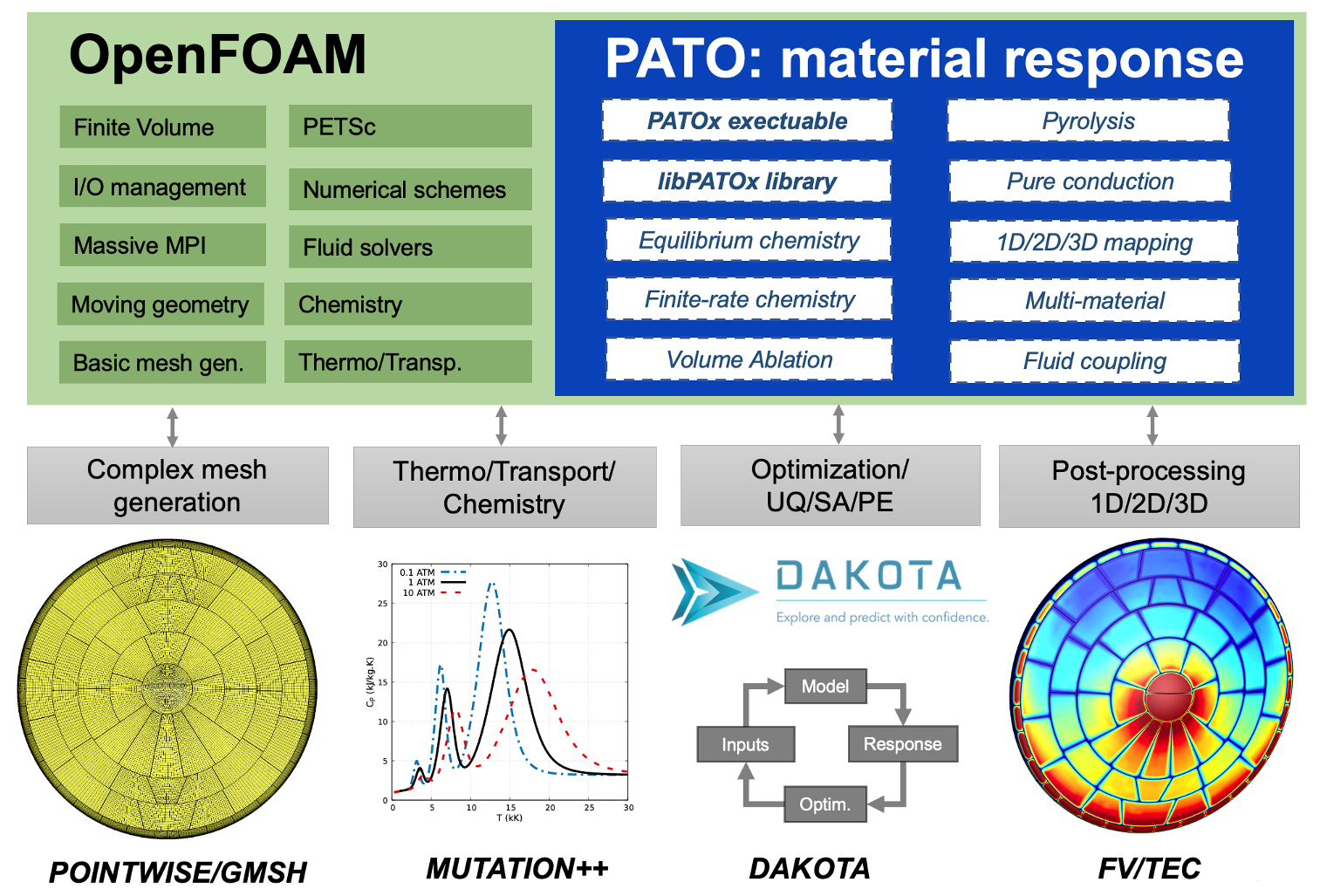
Overview of the PATO software which was implemented as a top-level module of OpenFOAM enabling the coupling to mesh generation, thermochemistry, optimization, and post-processing libraries.